






Analysis of the Beth Star
October 22, 2011 at 5:54 pm
(This post was last modified: October 22, 2011 at 6:44 pm by Cyberman.)
Ok - report time. Sorry it took so long. As the enclosed images are necessarily big, I'll hide them away for convenience.
Using the MNSBC slideshow for information, as Larson helpfully doesn't provide any, I set my observatory up at the approximate map reference for Babylon (taken from Wikipedia). Although the viewing location is important, we're in the general ballpark, so a few kilometres here and there aren't going to hurt.
Here's a screenshot I took of that observation. I made the ground translucent, but you'll have to ignore the trees I'm afraid.
You're looking at the constellation of Leo, with his characteristic sickle-shaped head, in the northwestern sky immediately after sunset on the evening of August 12, 3 BCE (a Monday, apparently). I've labelled the salient parts (also the Moon, just for interest's sake). As described, there is a prominent conjunction - or in astronomical terms, an occultation - of Jupiter and Venus in the general area of Regulus.
However...
Look where the horizon is. The Sun has now set, but our planets have already set about an hour and twenty minutes earlier; at that time the Sun was still up, though the evening was getting on. It's not clear from the simulation whether the planets would be visible in those conditions. On the one hand they are the two brightest planets in the sky, but then again they're not all that far removed from the glare of the Sun. And of course by the time they would have been perfectly visible, the ground's in the way. I can switch the ground on and off as I please but I don't think they had this capability back then. So basically it's anyone's guess here. My opinion based on experience is they likely were visible even before sunset, but who can really say for certain without proper field research?
Now, for reference I give you slide #8 clumsily cropped from the MSNBC article:
Comparing this image and my snapshot, you should notice immediately that the slideshow presents Leo totally inaccurately; there's no indication of which direction we're facing. This, coupled with the angle that Leo is drawn at, gives the misleading impression that he is rising in the East (actually more Southeast) instead of setting in the Northwest. I could put this down to artistic licence if not for the fact that they are purporting to present scientific information, in which case it's just as easy to get it right as it is wrong and certainly more important.
Jupiter-Mars are in the general area of the alpha star, but far from being near Regulus they are in fact much nearer Omicron Leonis, a magnitude 3.5 binary star also known as Subra. Although not as bright as Regulus it would definitely be naked-eye visible to our ancient observers - though I'm unaware of any astrological significance to this 'lesser' star. Maybe it's a pretender to the throne?
Now for the retrograde event. Larson has this to say about it: "In 3/2 BC, Jupiter's retrograde wandering would have called for our magus' full attention." Well, so much for Larson. Again the slideshow was more helpful, giving us a date of September 14 for Jupiter's close encounter with Regulus. (This next bit’s a little convoluted I'm afraid. I hope you’ll bear with me).
I sat and watched Jupiter glide smoothly past Regulus, close enough to qualify as a conjunction:
Around the middle of November it halted and began to turn back on its orbit on or about December 3rd:
encountering Regulus again on Valentine’s Day of 2 BCE (except of course St Valentine had yet to be born/invented):
then travelled to this point round about April Fool’s Day:
where it decided to go back and have another look, which it was able to do on or around May 8:
Phew!
Incidentally, take another look at that last image. See the little black blob sitting on the red line of Jupiter's orbit just behind my big white arrow? That's the Moon. Round about the middle of every month, regular as clockwork, she sped faithfully along that red line, passing right over Regulus each time. Just thought I'd throw that in there.
So basically, Jupiter did indeed perform the prescribed manoeuvre in the period 3-2 BCE.
However...
Let’s take a look at the time frame involved here. We’re talking about a period of nearly eight months for the full sequence of events to play out, during which time the bit of the sky we’re looking at looks more or less exactly the same on a nightly basis. We’re only able to see the movements without dedicated observation because we can speed up the simulated time. Of course, astronomers do this sort of thing all the time, but unless you know what you’re looking for you’re hardly likely to notice anything unusual going on at all.
One final point and I’ll bring this to a close. I took my snaps of the Regulus conjunctions when I judged Jupiter to be roughly at its closest approach to the star and I notice that the MSNBC article does the same. In fact, determining the precise moment of a conjunction isn’t so clear-cut. In this case, I estimated that Jupiter was close enough to Regulus to qualify as a conjunction for as much as a week each visit; with the naked eye observing the real thing, picking one single day out of that period would be impossible.
In summary: Jupiter, Venus and Regulus did indeed behave as the articles supposed, but over a period of many months requiring dedicated nightly observation by persons who must have known ahead of time what to look for. Add to that the fact that the notable events – Larson’s “identifying characteristics” – happened over a protracted timeframe, blurring the 'point' of conjunction and making specific dating impossible by eye. And the first of these events is questionable anyway.
I’ll tackle the last bit (about Jupiter, Venus and Regulus) some other time. I’m off for a rest.
Using the MNSBC slideshow for information, as Larson helpfully doesn't provide any, I set my observatory up at the approximate map reference for Babylon (taken from Wikipedia). Although the viewing location is important, we're in the general ballpark, so a few kilometres here and there aren't going to hurt.
Here's a screenshot I took of that observation. I made the ground translucent, but you'll have to ignore the trees I'm afraid.
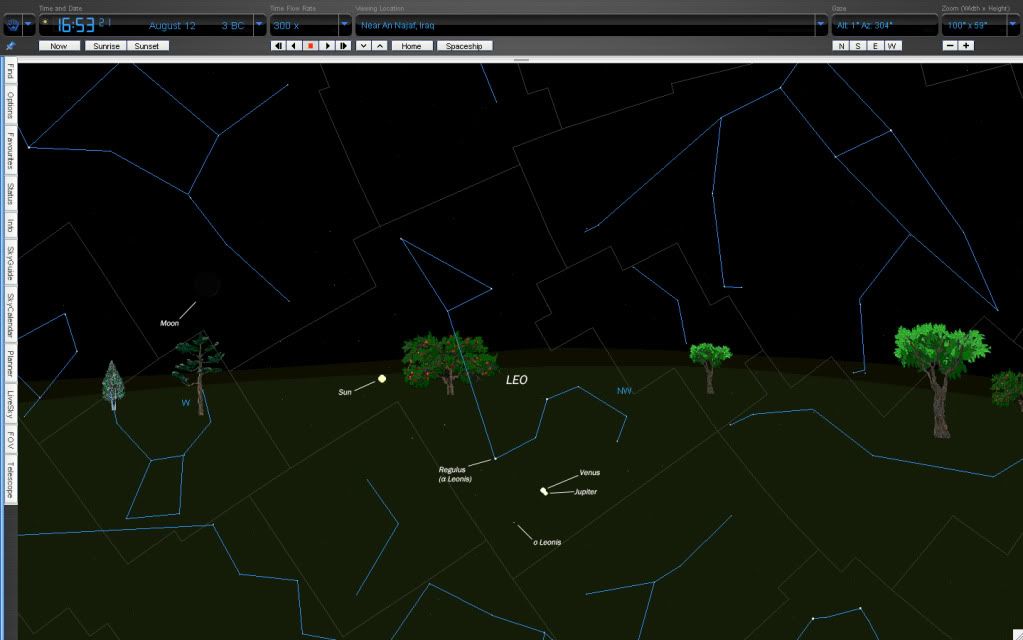
You're looking at the constellation of Leo, with his characteristic sickle-shaped head, in the northwestern sky immediately after sunset on the evening of August 12, 3 BCE (a Monday, apparently). I've labelled the salient parts (also the Moon, just for interest's sake). As described, there is a prominent conjunction - or in astronomical terms, an occultation - of Jupiter and Venus in the general area of Regulus.
However...
Look where the horizon is. The Sun has now set, but our planets have already set about an hour and twenty minutes earlier; at that time the Sun was still up, though the evening was getting on. It's not clear from the simulation whether the planets would be visible in those conditions. On the one hand they are the two brightest planets in the sky, but then again they're not all that far removed from the glare of the Sun. And of course by the time they would have been perfectly visible, the ground's in the way. I can switch the ground on and off as I please but I don't think they had this capability back then. So basically it's anyone's guess here. My opinion based on experience is they likely were visible even before sunset, but who can really say for certain without proper field research?
Now, for reference I give you slide #8 clumsily cropped from the MSNBC article:
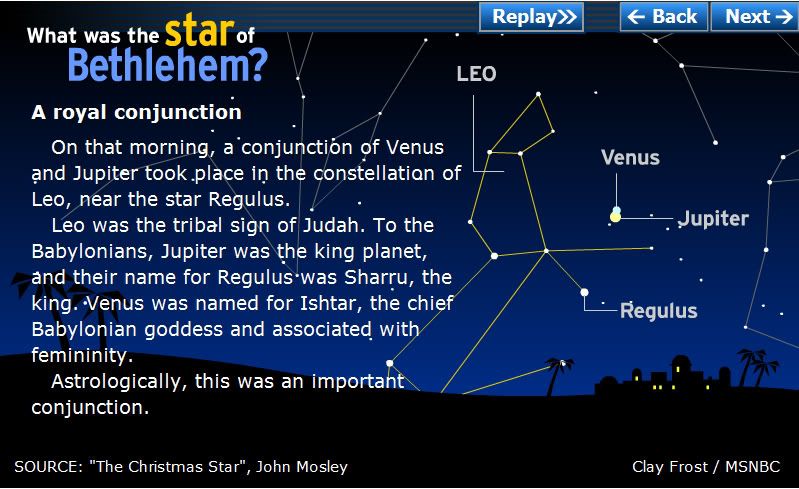
Comparing this image and my snapshot, you should notice immediately that the slideshow presents Leo totally inaccurately; there's no indication of which direction we're facing. This, coupled with the angle that Leo is drawn at, gives the misleading impression that he is rising in the East (actually more Southeast) instead of setting in the Northwest. I could put this down to artistic licence if not for the fact that they are purporting to present scientific information, in which case it's just as easy to get it right as it is wrong and certainly more important.
Jupiter-Mars are in the general area of the alpha star, but far from being near Regulus they are in fact much nearer Omicron Leonis, a magnitude 3.5 binary star also known as Subra. Although not as bright as Regulus it would definitely be naked-eye visible to our ancient observers - though I'm unaware of any astrological significance to this 'lesser' star. Maybe it's a pretender to the throne?
Now for the retrograde event. Larson has this to say about it: "In 3/2 BC, Jupiter's retrograde wandering would have called for our magus' full attention." Well, so much for Larson. Again the slideshow was more helpful, giving us a date of September 14 for Jupiter's close encounter with Regulus. (This next bit’s a little convoluted I'm afraid. I hope you’ll bear with me).
I sat and watched Jupiter glide smoothly past Regulus, close enough to qualify as a conjunction:
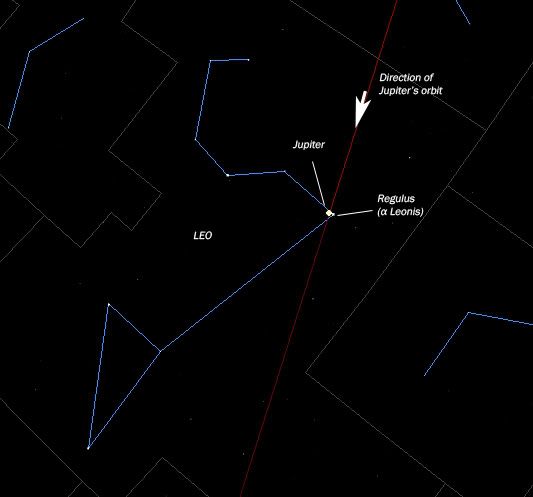
Around the middle of November it halted and began to turn back on its orbit on or about December 3rd:
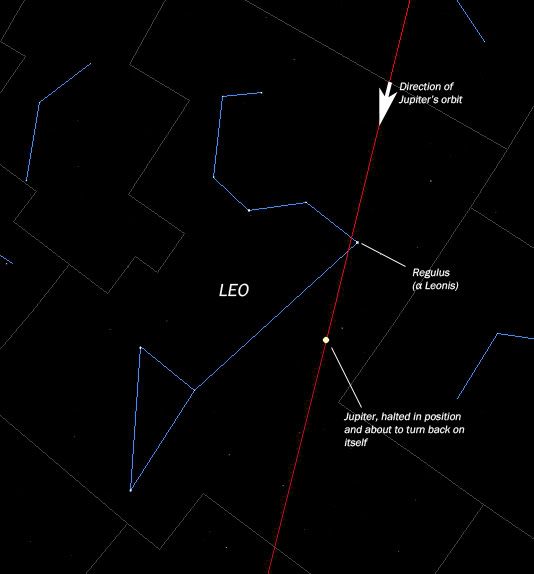
encountering Regulus again on Valentine’s Day of 2 BCE (except of course St Valentine had yet to be born/invented):
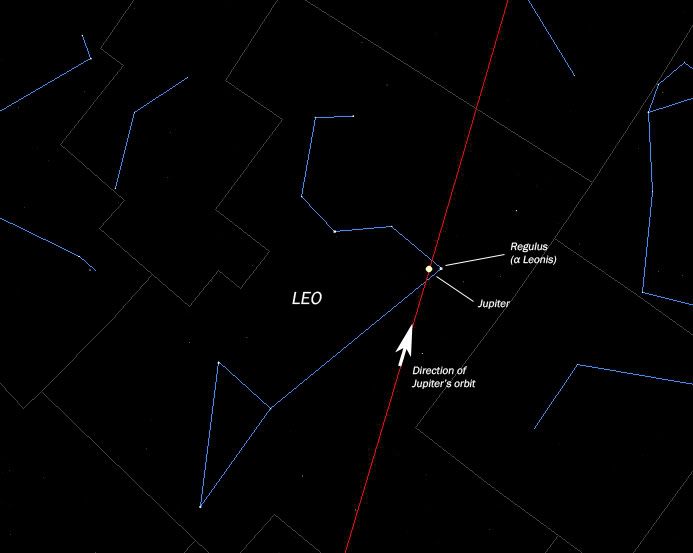
then travelled to this point round about April Fool’s Day:
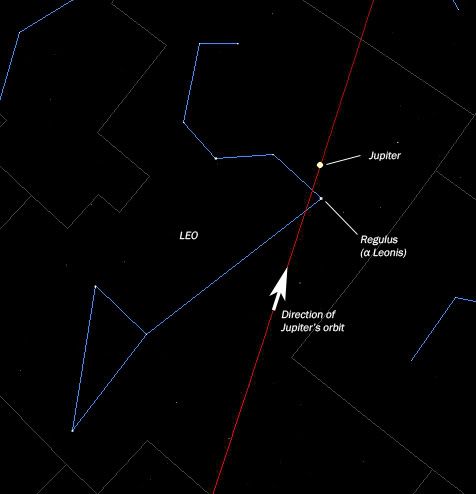
where it decided to go back and have another look, which it was able to do on or around May 8:
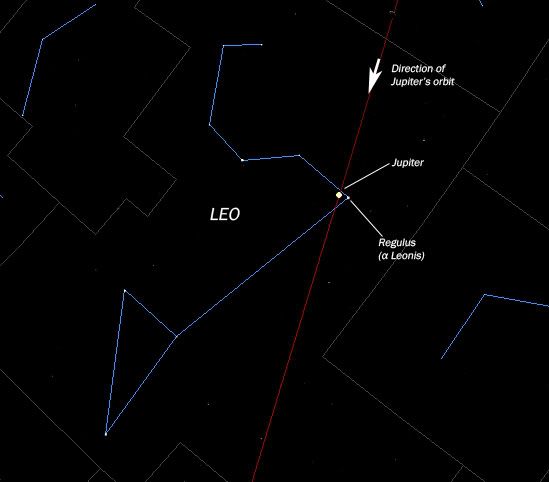
Phew!
Incidentally, take another look at that last image. See the little black blob sitting on the red line of Jupiter's orbit just behind my big white arrow? That's the Moon. Round about the middle of every month, regular as clockwork, she sped faithfully along that red line, passing right over Regulus each time. Just thought I'd throw that in there.
So basically, Jupiter did indeed perform the prescribed manoeuvre in the period 3-2 BCE.
However...
Let’s take a look at the time frame involved here. We’re talking about a period of nearly eight months for the full sequence of events to play out, during which time the bit of the sky we’re looking at looks more or less exactly the same on a nightly basis. We’re only able to see the movements without dedicated observation because we can speed up the simulated time. Of course, astronomers do this sort of thing all the time, but unless you know what you’re looking for you’re hardly likely to notice anything unusual going on at all.
One final point and I’ll bring this to a close. I took my snaps of the Regulus conjunctions when I judged Jupiter to be roughly at its closest approach to the star and I notice that the MSNBC article does the same. In fact, determining the precise moment of a conjunction isn’t so clear-cut. In this case, I estimated that Jupiter was close enough to Regulus to qualify as a conjunction for as much as a week each visit; with the naked eye observing the real thing, picking one single day out of that period would be impossible.
In summary: Jupiter, Venus and Regulus did indeed behave as the articles supposed, but over a period of many months requiring dedicated nightly observation by persons who must have known ahead of time what to look for. Add to that the fact that the notable events – Larson’s “identifying characteristics” – happened over a protracted timeframe, blurring the 'point' of conjunction and making specific dating impossible by eye. And the first of these events is questionable anyway.
I’ll tackle the last bit (about Jupiter, Venus and Regulus) some other time. I’m off for a rest.
At the age of five, Skagra decided emphatically that God did not exist. This revelation tends to make most people in the universe who have it react in one of two ways - with relief or with despair. Only Skagra responded to it by thinking, 'Wait a second. That means there's a situation vacant.'
